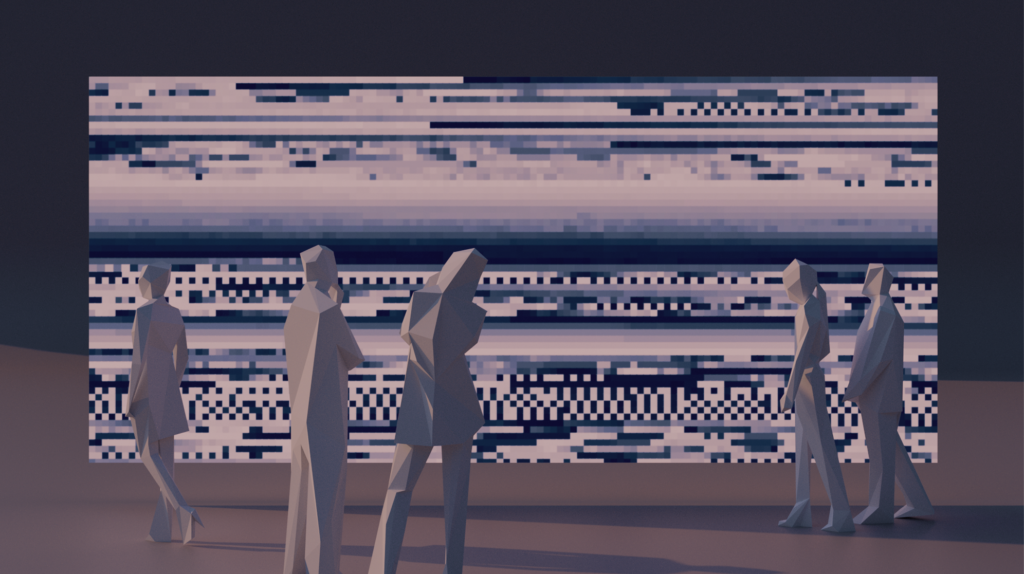
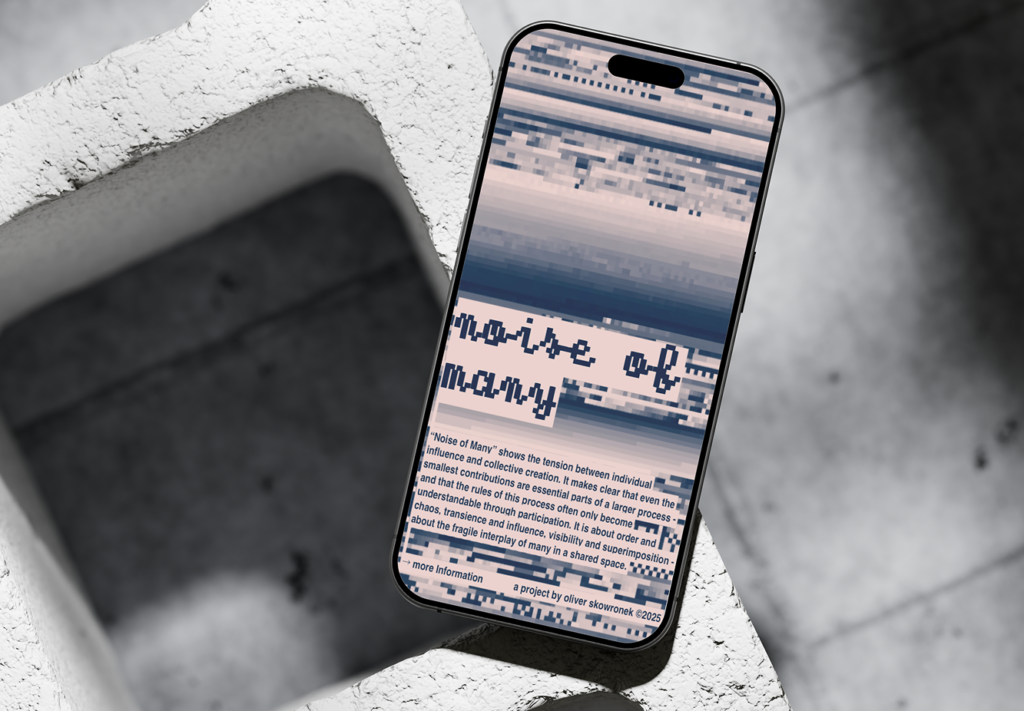
Most systems designed for collective participation make individual action legible. Noise of Many inverts this. Each click changes a single pixel in a shared image permanently, but in almost all cases invisible to the person who made it. The image belongs to everyone who contributed and resembles no one, yet everyone.
The work started from a specific observation: online participation has largely been reorganized around consumption, and platforms track and monetize individual behavior while keeping collective structure opaque. The question was whether a system could do the opposite, making collective structure visible while the individual contribution dissolves into it.
Built as a web application backed by a real-time database, every click is stored and translated immediately onto a shared canvas, marked by a brief visual flash before dissolving into the accumulated image. With no author and no moderator, the canvas records aggregation rather than coordination. What accumulates is itself a form of noise, an order that emerges from statistical superimposition.
Rancière's concept of the distribution of the sensible shaped the framing: what gets to appear within a shared perceptual field? A single click is statistically negligible. In aggregation, however, these clicks compose something. The work lives in that gap between individual action and collective effect. Mouffe's writing on democratic paradox adds a second frame: democratic participation does not converge toward consensus. The image Noise of Many accumulates reflects this. It is not legible as a collective decision.
A prototype is accessible at eeeh.fun.