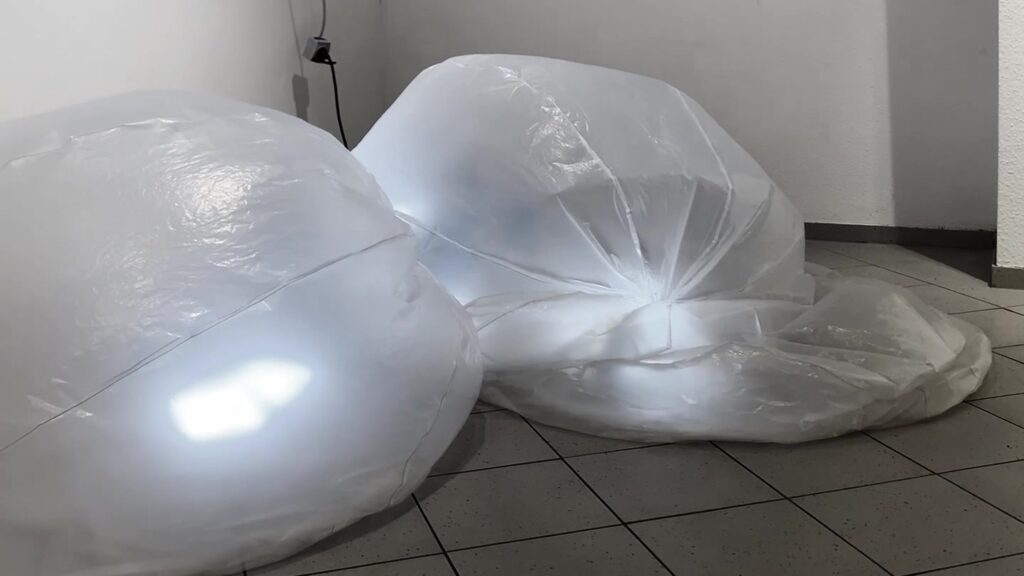
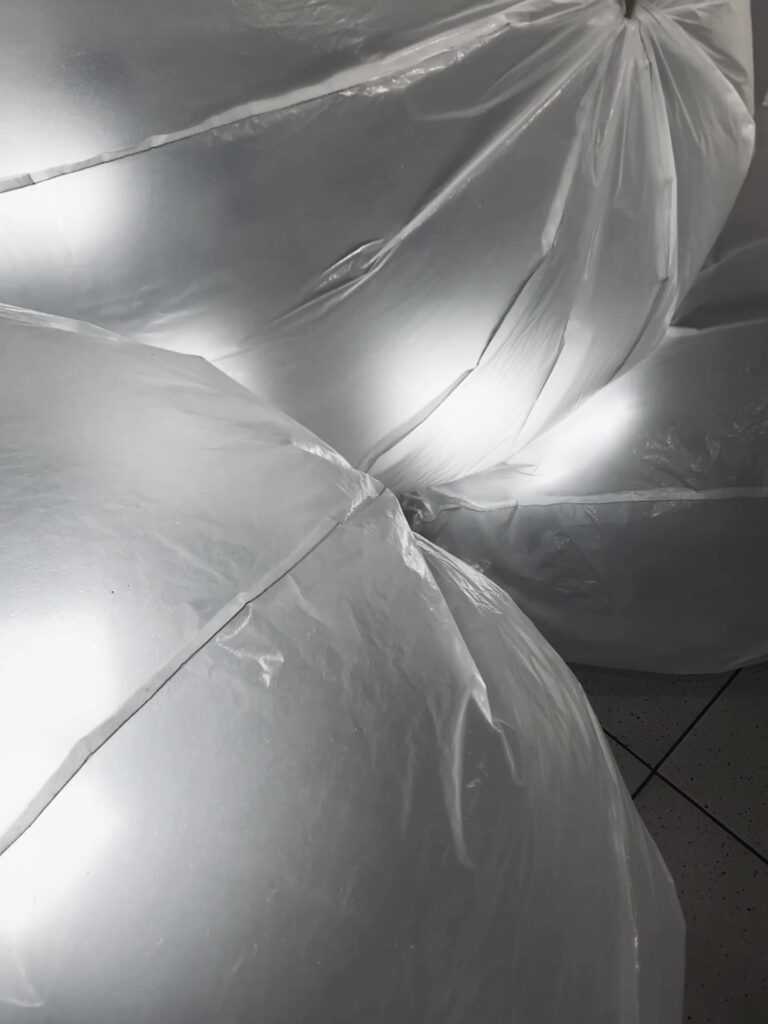
The work is about coexistence. To examine how individuals share space, I started from the cell, the smallest unit of biological life. A cell functions on its own, but in living organisms typically occurs in collectives.
The installation consisted of three such bodies. Each cell is a semi-transparent inflatable made of plastic film. Two LED panels sit inside, and a repurposed computer fan is mounted at the opening. A small board with a microcontroller, power supply, and two MOSFETs drives the components. When plugged in, the microcontroller runs a program that varies light intensity through flicker and pulse. The frequencies are loosely based on relative speeds of metabolic processes inside cells, taken from biology papers rather than precisely modeled. These rhythms are layered, producing a light behavior that does not loop predictably. A similar algorithm drives the fan. Each body inflates and deflates in its own rhythm.
Each microcontroller reads its internal temperature and an external light sensor. Ambient conditions shift the speed of every process. The three bodies were placed close together. They pressed into one another, leaned, rubbed against their neighbors, held each other up, pushed each other down. Sometimes giving, sometimes taking. Sometimes a tree, sometimes a dog.
This was the first piece in my practice that addressed coexistence between multiple units. The question of how individuals share space without coordination was already in the image.
Exhibited at Galerie Strömung Augsburg, 2023